3I/ATLAS CONSOLE Source

v1.0: live in your browser

3I/ATLASANOMALY REVIEW CONSOLE

A mission-control console that tracked interstellar object 3I/ATLAS on real JPL trajectories, logging each anomaly as it happened.

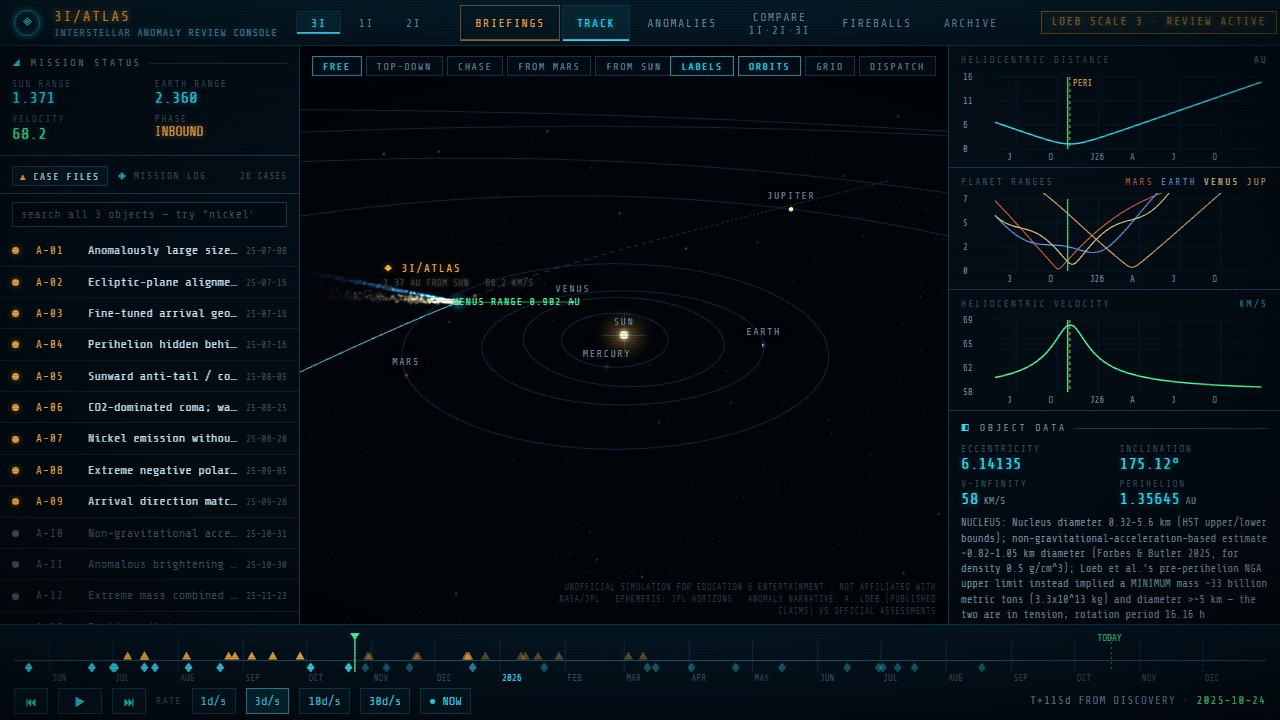
CAM 01 // REAL TRAJECTORY, THEN CASE A-05

Runs in any modern browser, on a laptop or a phone. No install, no account. The same console also builds into one offline HTML file.

3
INTERSTELLAR OBJECTS
49
CASE FILES
58
TIMELINE RECORDS
8
QUESTION BRIEFINGS
1,069
LOGGED FIREBALLS

THE PREMISE

Three objects have ever been seen arriving from outside the solar system. One of them has drawn a long list of arguments about whether it is only a comet.

1I/ʻOumuamua passed through in 2017 and sped up on its way out with no visible tail. 2I/Borisov arrived in 2019 and behaved like an ordinary comet. 3I/ATLAS came through in 2025 on the most extreme hyperbolic orbit ever measured, and Harvard astronomer Avi Loeb began publishing a numbered list of things about it he considered anomalous. Most astronomers say it is a comet. The console does not pick for you: it puts each claim next to the mainstream account, with sources, and lets you fly the geometry and judge.

01 / REPLAY

Fly the real geometry

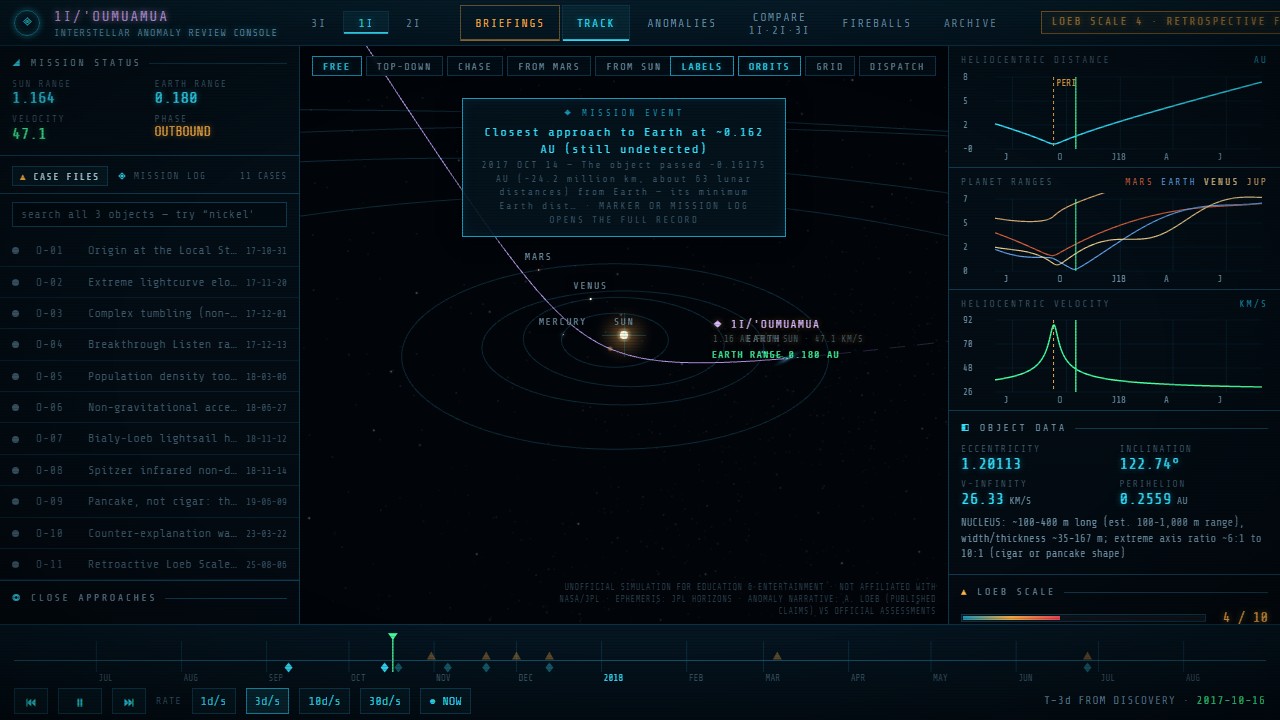
Daily state vectors for each object and all eight planets come from the NASA/JPL Horizons system, a separate window for each object's transit. Press play and the clock runs from discovery on 2025-07-01. Amber triangles mark anomaly case files, cyan diamonds mark mission events, and each one toasts when the playhead crosses it.

The close approaches are computed from those vectors and match the published values: 3I/ATLAS passes Mars at 0.194 AU on 2025-10-03, reaches perihelion at 1.357 AU on 2025-10-29, and is closest to Earth at 1.798 AU on 2025-12-19. Cameras include free, top-down, chase, from Mars and from the Sun.

CAM 02 // DISCOVERY ONWARD, 30 DAYS PER SECOND

02 / CASE FILES

Both sides of every claim

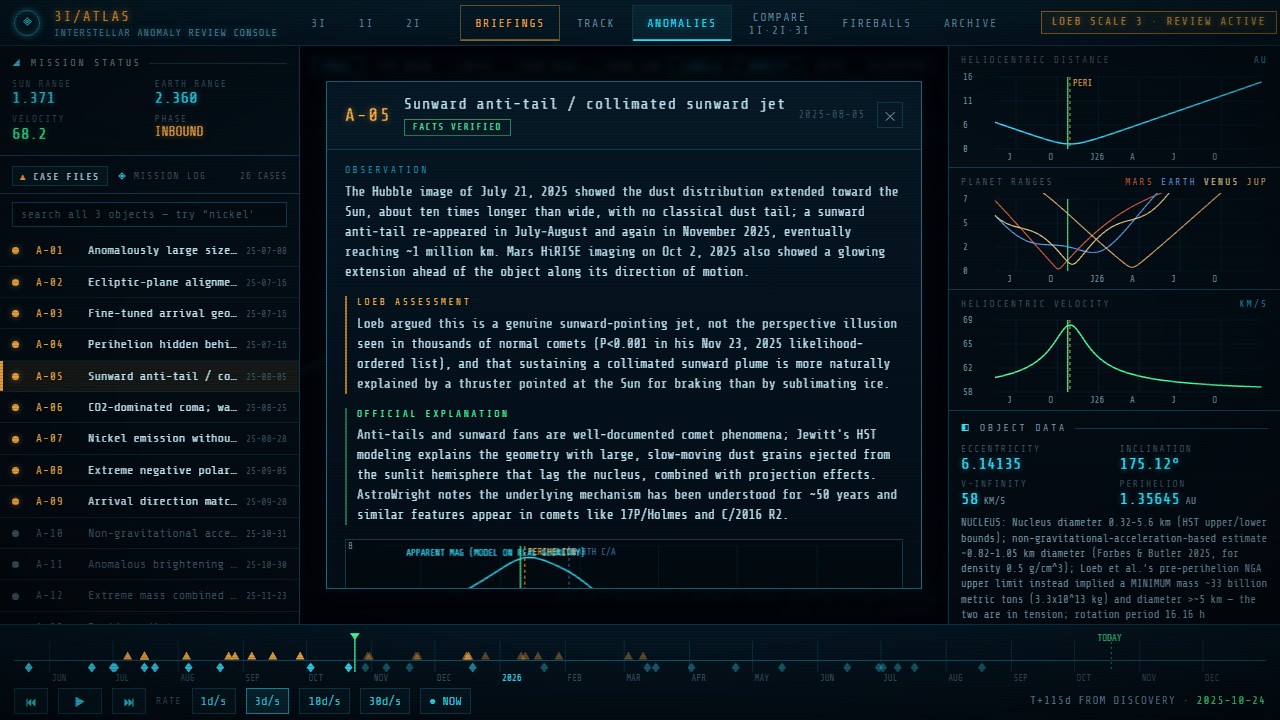
Every anomaly is a numbered case file with three parts: the observation, what was measured; the assessment, which is the claim as Avi Loeb made it; and the official explanation, the mainstream account with its own paper trail. Sources are links, and a chip records whether the entry held up when it was checked.

The console is fun speculation grounded in real data, not a scoreboard against the people making the claims. Where a dataset cannot speak to a claim, the case says so instead of implying a refutation.

DOSSIER A-05 // SUNWARD ANTI-TAIL Case file A-05, a sunward anti-tail, with the observation, the Loeb assessment and the official explanation stacked in one dossier.

03 / BRIEFINGS

A way in, by question

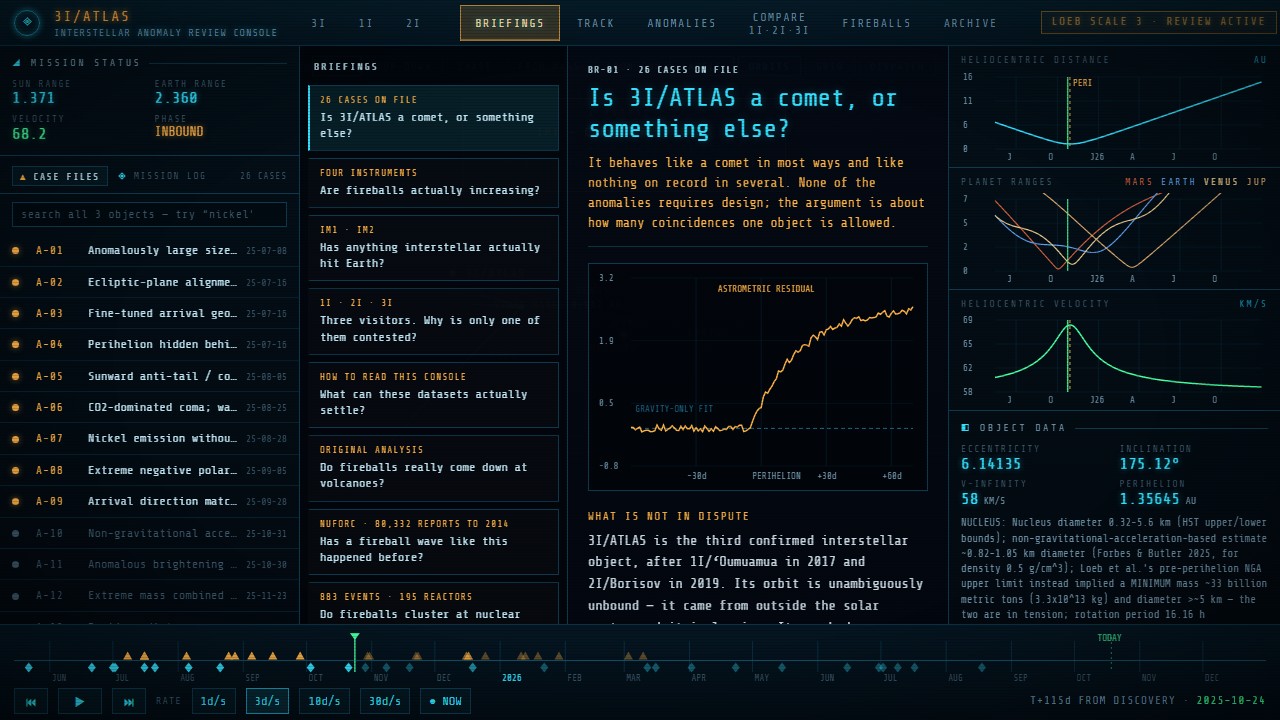
Forty-nine dossiers is a wall, so there are eight briefings, each built around one question: is 3I/ATLAS a comet or something else, are fireballs actually increasing, has anything interstellar hit Earth, why is only one of the three visitors contested.

A briefing states the question, answers it in a few hundred words, shows the one chart that carries the argument, and hands off to the case files that do the detailed work. Each is a deep link, so a single finding can be sent on its own.

BRIEFINGS // READING MODE

04 / IMPACT MAP

1,069 fireballs, and two disputed rows

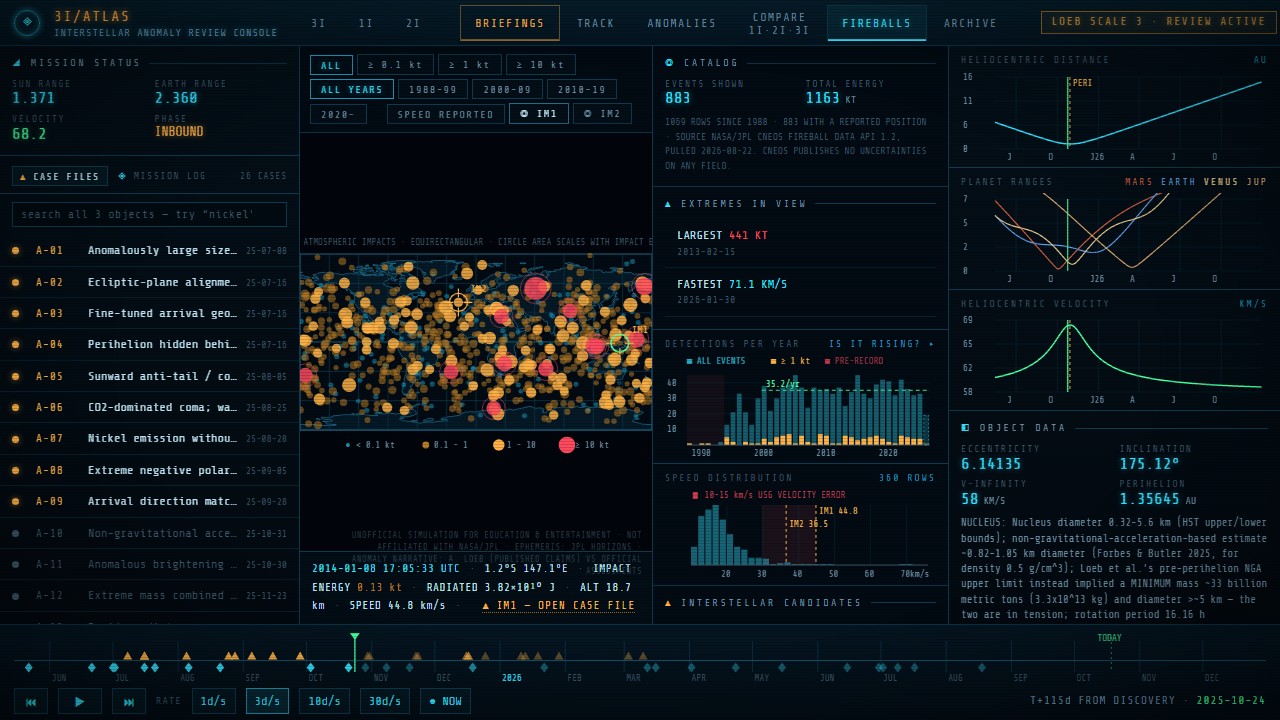
Every atmospheric impact that US Government sensors have logged since 1988 is plotted where it burned, with circle area scaling with energy up to Chelyabinsk at 441 kt. Filter by energy or decade, hover a dot for its full CNEOS row, and put IM1 (2014) and IM2 (2017), the two events Loeb argues came from outside the solar system, under a reticle.

The catalog publishes no uncertainties on any field, which sits at the center of the IM1 and IM2 dispute, and the console says so wherever those numbers appear.

IMPACT REGISTER // CNEOS

HOW IT WAS MADE

One plain HTML file, no framework, and every number traceable to a script that fetched it.

Stewart Gregerson built the console with Claude Code, in short sessions that each pick up from a resume note kept in the repo. The 3D scene is three.js and the sound is a Web Audio synth with no audio files. A Python build step inlines three.js, the font, the ephemeris, the fireball catalog and all the case files into one file of about 1.6 MB with zero external references, so it opens offline by double-click.

Data by script

Python scripts pull the JPL Horizons vectors, the CNEOS fireball table and the other datasets, then bake them into the bundle. A monthly workflow re-pulls upstream and opens a pull request if anything changed. It never pushes to main, because a row a case file quotes can be revised upstream and a person should read the diff.

Cases that get checked

The original case files, timelines and quotes came from a multi-agent research pass, then each case went through an adversarial fact-check against primary sources. One script re-derives every figure the fireball-rate cases quote and fails the refresh if the catalog moves under them.

Mistakes get written down

The changelog records what broke. In v2.18.1 the dossier was putting Avi Loeb's name on quotes that were not his, so the prefix now appears only on his own cases. The note ends: putting a real person's name on somebody else's sentence is the one class of error this project can least afford.

  1. First commit. A single-file console with the three objects, real Horizons trajectories and the first case files.
  2. v2.3. Deep links to any case, an eight-beat guided tour and search across all three objects.
  3. The fireball register. The CNEOS impact map, cases for IM1 and IM2, touch support, and timeline markers that open full sourced records.
  4. Briefings, and three instruments. A question-led way into the cases, and the fireball-rate claim tested against more than one dataset.
  5. A fourth instrument, the DISPATCH overlay and the attribution fix. NASA's GLM satellite catalog sees daylight, which closes a limit the case had stated against itself.

Read the full changelog

DATA SOURCES AND CREDITS

SourceUsed forTerms
NASA/JPL HorizonsTrajectories for 3I/ATLAS, 1I/ʻOumuamua, 2I/Borisov and the planetsPublic domain
NASA/JPL CNEOS Fireball Data APIThe impact map: every logged fireball since 1988US government data, public domain
Natural EarthLand outlines on the impact mapPublic domain
NASA GLM bolide catalogSatellite detections that include daytime eventsPublic NASA data; detections used as published
Global Meteor NetworkMonthly camera statistics for the fireball-rate casesAggregates only, credited to the network
American Meteor SocietyEyewitness report counts per monthPublic statistics page; aggregates only
NOAA NCEI volcano locationsThe volcano-proximity testUS government data
WRI Global Power Plant DatabaseReactor positions for the nuclear-site testCC BY 4.0
NUFORC archive (planetsig/ufo-reports mirror)The 2013 sighting-share precedent; the mirror ends in 2014Aggregates only; raw report text is not kept
three.jsThe 3D sceneMIT
Share Tech MonoThe typeface, here and in the consoleSIL Open Font License 1.1

Quotations in the case files remain the property of their speakers and publishers and are used briefly, with attribution, for commentary and criticism. The code is MIT.